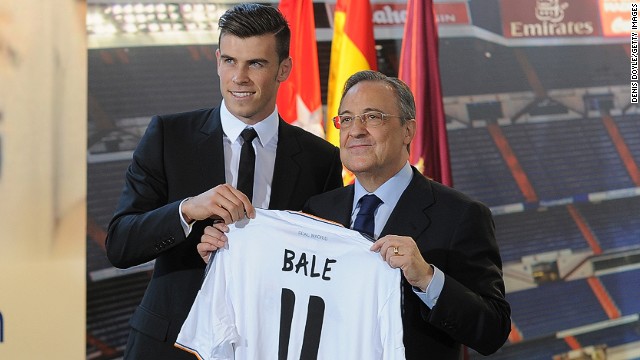
So... Transfer deadline day is finally over, much to the relief of many football fans. Along with that, Bale's transfer saga, which was FINALLY concluded last Sunday, with the former Tottenham player making his 'dream move' to Real Madrid was a extortionate fee of £85 million!!! But how can Real Madrid, or any club for that matter, afford this humongous fee?
Over the past 13 years, Real Madrid and their President, Florentino Perez, have broken the world record transfer five times - Figo in 2000, Zidane in 2001, Kaka and then Ronaldo in 2009 and now of course Bale in 2013. Those five players cost a rather cool £303.6m!
But it is what Real Madrid can afford, not surprisingly, with the club earning £415 million in 2012 - hence making them the wealthiest club in the world (as stated in one of my earlier blogs). Perez argues anyway that the big marquee signings will pay off in replica shirt sales and sponsorship.
But still, how can clubs all over the world afford and justify paying huge sums for players. Even Arsene Wenger, who is seen in world football as the stingiest of them all spent a massive £42 million on Mesut Ozil.
Well once again, it's all down to pay TV. Starting from this season, clubs in the Premier League will benefit from the new £5.5bn, three-year deal for domestic and overseas TV rights. Much of this - £3bn - comes from Sky and BT Sport. The competition between these two companies has helped inflate the football economy to unprecedented levels. The bigger clubs will get a larger share of the TV money, the reason why they can afford to buy these big name players.
Anyway...moving on...
 Every time an Andy Carroll or Jordan Henderson, or Jack Rodwell get sold and Liverpool (over-)pay for British-born players, the idea of an English (or sometimes, British) premium is bandied about.
But... is it really true that you have to pay a premium for English players? The underlying idea here is that there is positive discrimination in the English player market, with selling clubs charging a little (or a lot) extra for English or British players.
A study was recently undertook to find out if the 'British Premium' exists in reality. To figure out if there is evidence of a premium, it conducted several regression analyses to see if a player's "Britishness" is a significant predictor of his market value once it takes into account a variety of factors that also might determine how much he goes for - things like age, his contract year, which club he plays for, position, etc.
The results covered from the investigation are as follows:
Non-British: £7.45
British: £5.07
Non-English: £6.97
English: £4.99
To see how this plays out, the models can be used with some fancy math to determine how the market values two identical players. Take two 25-year old midfield players who are - for the sake of argument - identical and average in every other way. The prediction for the British player would be that he is valued at £3.96 million; for the non-Brit, the model predicts £6.58 million. Or take the average 28-year old forward for example; the Brit would be valued at £4.74 million; the equivalent player from elsewhere £7.36.
So can the myth be dispelled? Well there exceptions to the rule, with players such as Andy Carroll costing £35 million, and other names, but in relation to foreign imports, it can be concluded that British players are significantly cheaper, much to the surprise of some.
So maybe, clubs should start investing in local talent instead, grabbing themselves a bargain and on the bigger scale - helping out the national team, which is clearly lacking in top quality.
